2026-03-16
Content
Yes, ball valves can absolutely be used for water — and in many scenarios, they are the preferred choice over gate valves, globe valves, and butterfly valves. Ball valves provide a tight, reliable shutoff, handle both cold and hot water, and are available in materials rated for potable (drinking) water systems. From residential plumbing under kitchen sinks to large-scale industrial water treatment plants, ball valves are found at virtually every level of water infrastructure.
That said, not every ball valve on the shelf is appropriate for every water application. Material selection, pressure and temperature ratings, seat material, and end-connection type all determine whether a specific valve is the right fit. This guide walks through everything you need to know to select, size, and install ball valves correctly in water systems.
A ball valve controls flow by rotating a spherical plug — the ball — that has a bore drilled through its center. When the bore aligns with the pipe, water flows freely. Rotating the handle 90 degrees moves the solid side of the ball to face the flow path, blocking it completely. This quarter-turn operation is one of the biggest functional advantages over gate valves, which require multiple full rotations to open or close.
The result is a fast, positive shutoff that takes roughly one second. In emergency situations — a burst pipe, a leaking appliance, a system that needs to be isolated quickly — that speed matters considerably. The mechanism also has fewer moving parts than most other valve types, which contributes to long service life and reduced maintenance frequency.
Ball valves come in two main bore configurations. A full port (full bore) ball valve has a bore diameter equal to the inner diameter of the pipe, which means it introduces essentially zero pressure drop across the valve. A reduced port (standard port) ball valve has a bore one pipe size smaller than the nominal pipe diameter, which creates a slight pressure restriction.
For most residential water shutoff applications, a reduced port valve is fine — the pressure drop is negligible when the valve is fully open. But for water systems where flow rate is critical, such as irrigation mains, fire suppression lines, or water transfer pumps, full port ball valves are strongly recommended. Pressure loss across a reduced port valve in a 2-inch line can reach 1–3 psi at typical residential flow rates, which compounds across multiple valves in a system.
Material selection is one of the most important decisions when specifying ball valves for water service. The body, ball, stem, and seat all need to be compatible with the water type — whether that's potable water, treated wastewater, deionized water, or seawater. Here is a breakdown of the most commonly used materials:
| Material | Common Water Use | Max Temp (Typical) | Potable Water Safe | Notes |
|---|---|---|---|---|
| Brass | Residential plumbing, hot & cold water | 200°F (93°C) | Yes (NSF 61 rated) | Most common for residential use; check lead-free compliance |
| Stainless Steel (316) | Industrial, food-grade, seawater | 400°F (204°C) | Yes | Excellent corrosion resistance; higher cost |
| PVC (Plastic) | Cold water, irrigation, chemical water | 140°F (60°C) | Yes | Lightweight, corrosion-proof; not suitable for hot water |
| Bronze | Marine, high-pressure water | 250°F (121°C) | Yes | Strong, corrosion-resistant; heavier than brass |
| CPVC | Hot water, residential | 200°F (93°C) | Yes | Better heat tolerance than standard PVC |
In the United States, the Reduction of Lead in Drinking Water Act (effective January 2014) mandates that any valve contacting potable water must contain no more than 0.25% lead by weighted average. Traditional brass ball valves could contain up to 8% lead, which is no longer acceptable for drinking water contact. When purchasing brass ball valves for potable water service, look explicitly for "lead-free brass" or "LF brass" labeling, and verify NSF/ANSI 61 certification, which is the standard for drinking water system components.
Stainless steel and PVC ball valves are naturally lead-free, making them straightforward choices from a compliance standpoint. For applications outside the U.S., check local regulations — the European Union follows EN 12165 and the Drinking Water Directive, which similarly restrict heavy metal content.
The seats and seals inside ball valves are just as important as the body material. PTFE (Teflon) seats are the industry standard for water applications — they are chemically inert, handle temperatures from -40°F to 400°F, and provide bubble-tight shutoff. EPDM (Ethylene Propylene Diene Monomer) is another common seal material, particularly in PVC ball valves used for water and mild chemical service; it handles temperatures up to 250°F and resists oxidizing water well. Buna-N (nitrile) seals are less common in water valves but sometimes appear; they are better suited to oil and gas service.
Every ball valve carries a pressure-temperature (P-T) rating, and this rating must match or exceed the conditions of your water system. Ignoring P-T ratings is one of the most common and most dangerous mistakes in valve selection.
Standard residential water supply pressure in the U.S. runs between 40 and 80 psi, with 60 psi being typical. Municipal systems occasionally spike to 100 psi during demand fluctuations. A standard brass ball valve rated at 600 WOG (Water, Oil, Gas) provides far more than enough margin for residential applications — WOG ratings in ball valves indicate the cold-working pressure in psi. For hot water service, note that pressure ratings decrease with temperature; a valve rated 600 WOG at ambient temperature may only be rated 150 psi at 300°F.
Industrial water systems — cooling towers, boiler feed lines, high-pressure washing systems — can exceed 300 psi and operate at elevated temperatures. In these environments, you need ball valves with appropriate ANSI class ratings (Class 150, 300, 600, etc.) and materials rated for continuous high-temperature service, such as carbon steel or stainless steel bodies with metal seats instead of PTFE.
Because ball valves close in a single quarter-turn, they can cause water hammer — the pressure surge that occurs when flowing water is suddenly stopped. In large-diameter pipes or high-velocity water systems, water hammer can generate transient pressures 5 to 10 times the normal operating pressure, potentially damaging pipes, fittings, and connected equipment.
To mitigate this, larger water systems use slow-closing ball valves with geared operators or actuators that extend the closure time to several seconds. Water hammer arrestors installed near the valve are another practical solution for residential applications. For pipes 4 inches and larger, engineers often specify butterfly valves or plug valves with slow-close operators rather than standard ball valves, specifically to avoid this issue.
Not all ball valves share the same design. Several configurations exist, each suited to specific water system requirements.
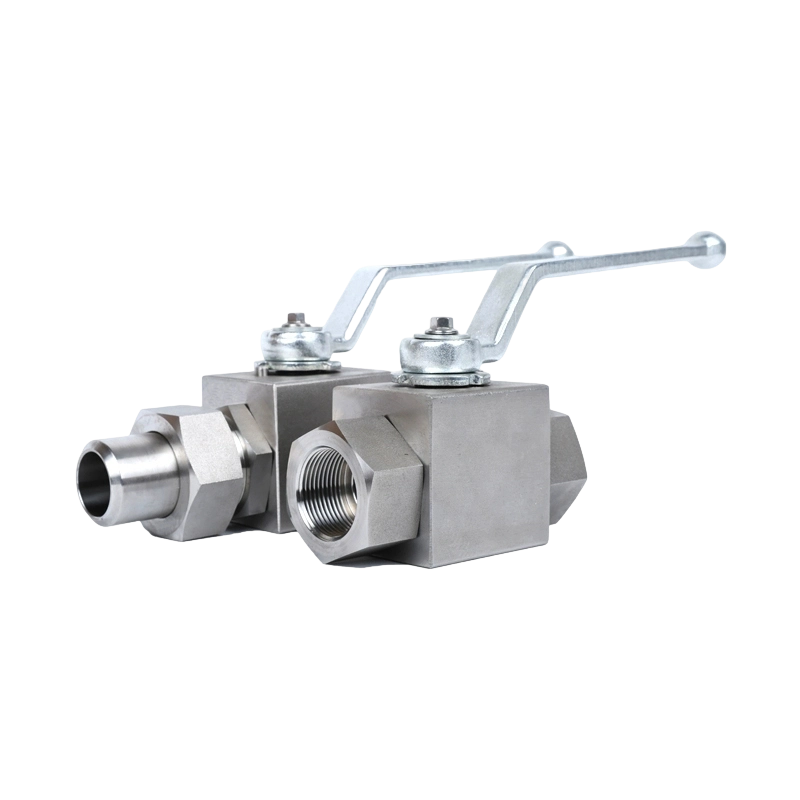
The most common type, a two-way ball valve has a single inlet and a single outlet. It is used strictly for on/off control of water flow through a single pipe run. These are the standard shutoff valves found under sinks, behind toilets, at water heater connections, and at main water service entries.
A three-way ball valve has three ports and an L-port or T-port ball. An L-port allows flow between two of the three ports in two different switching positions — useful for diverting water from one line to another. A T-port can simultaneously connect all three ports or mix flows. Three-way ball valves are common in water recirculation systems, hydronic heating circuits, and water treatment systems where flow needs to be directed between multiple paths without installing multiple separate valves.
Float ball valves — commonly found in toilet tanks and water storage tanks — operate automatically based on water level. As water rises, a floating ball lifts the arm attached to the valve, closing off the water supply inlet. These are technically a subset of ball valve but function quite differently from manually operated quarter-turn valves. They use a rubber seat and a float-controlled plunger rather than the standard spherical ball design.
Ball valves can be fitted with electric actuators, pneumatic actuators, or hydraulic actuators for remote or automated operation. Electric actuated ball valves are widely used in irrigation systems (zone control), water treatment facilities (automated dosing or bypass control), and building management systems. A 24V or 110V electric actuator can open or close a ball valve in as little as 5–15 seconds, with feedback signals confirming valve position. These systems are increasingly common as smart home water control systems automate shutoff valves linked to leak sensors.
Understanding where ball valves outperform alternatives — and where they fall short — helps ensure you specify the right valve for each water system function.
| Valve Type | Best For | Not Ideal For | Relative Cost |
|---|---|---|---|
| Ball Valve | Fast shutoff, tight sealing, frequent operation | Throttling/flow regulation | Low–Medium |
| Gate Valve | Infrequent full-open/full-close, large pipe mains | Frequent cycling, emergency shutoff | Low |
| Globe Valve | Flow throttling, precise regulation | High-flow, low pressure drop requirements | Medium |
| Butterfly Valve | Large diameter water mains (6"+ pipe), space-saving | High-pressure tight shutoff in small sizes | Low (large sizes) |
| Check Valve | Preventing backflow, one-direction flow | Manual flow control | Low–Medium |
One area where ball valves are consistently misused is flow throttling. Partially opening a ball valve to reduce water flow creates turbulent, high-velocity flow around the edge of the ball, which causes accelerated seat erosion and can damage the valve body over time. For applications requiring precise flow regulation — such as balancing a hydronic heating system or controlling irrigation drip rates — a globe valve or needle valve is the appropriate choice.
Ball valves appear in nearly every segment of water infrastructure. Here is a look at specific applications and what to consider in each:
The main water shutoff valve entering a home is frequently a ball valve, particularly in newer construction. A ½-inch or ¾-inch lead-free brass ball valve handles the typical 40–80 psi residential supply pressure without issue. Ball valves are also installed as individual fixture shutoffs under sinks, behind toilets, and at washing machine connections — locations that benefit from quick, reliable closure in the event of a leak.
In residential water heater installations, ball valves serve as the cold-water supply shutoff (at the inlet) and are sometimes also installed on the hot-water outlet. This allows the water heater to be isolated for maintenance or replacement without shutting off water to the entire house. Many plumbing codes require a shutoff valve within 18 inches of the water heater connection.
PVC ball valves are the workhorse of residential and commercial irrigation systems. They handle the relatively low operating pressures (20–60 psi) in irrigation lines, resist UV exposure when UV-stabilized PVC compounds are used, and are inexpensive enough to be installed at every zone branch point without significantly increasing system cost. For above-ground irrigation manifolds, ¾-inch or 1-inch PVC ball valves are standard.
In drip irrigation systems, miniature ball valves as small as ¼-inch are used to shut off individual drip lines for seasonal maintenance or replanting. Actuated ball valves controlled by irrigation timers or smart controllers handle automated zone switching in larger commercial landscapes and sports fields.
Ball valves are used extensively in water filtration systems — whole-house sediment filters, reverse osmosis units, water softeners, and UV purification systems all rely on ball valves for isolation during filter cartridge changes or media replacement. The typical configuration places a ball valve on the inlet and outlet of each filter housing, with a bypass valve allowing water to flow around the filter while it is serviced.
In reverse osmosis systems, a dedicated ball valve shuts off the feed water supply. The small size (typically ¼-inch or 3/8-inch) and low operating pressure of RO systems make PVC or stainless steel mini ball valves ideal. For water softener installations, a three-valve bypass assembly — consisting of two shutoff ball valves and one bypass ball valve — is standard, allowing the softener to be taken offline without interrupting water service to the building.
In industrial water systems — cooling towers, process water loops, chilled water systems, and boiler feed water — ball valves are used for equipment isolation, drain and vent connections, chemical injection points, and sampling ports. Stainless steel ball valves rated to 1000 WOG are common in these environments. Trunnion-mounted ball valves (where the ball is supported by upper and lower trunnions rather than floating against the seats) are used for larger diameter pipes (4 inches and above) and higher pressure applications because they reduce operating torque and seat wear.
Municipal water treatment plants use ball valves extensively for chemical dosing systems — chlorine, fluoride, coagulants — where the compact size and reliable shutoff of a ball valve suits the small-diameter, chemical-resistant piping typical in chemical feed applications. PVDF (polyvinylidene fluoride) or 316 stainless steel ball valves are specified in these areas due to the aggressive nature of the chemicals involved.
Correct sizing ensures the valve handles the required flow rate without excessive pressure drop and that the physical connection matches the pipe size in the system. Here are the key steps:
Proper installation is critical to valve performance and service life. Even a correctly selected valve can fail prematurely or leak if it is installed incorrectly.
Ball valves are among the lowest-maintenance valve types available. A quality brass or stainless steel ball valve installed correctly in a water system can last 20 to 50 years with essentially zero routine maintenance. However, certain conditions can shorten that life significantly.
Ball valves are generally not worth repairing. Unlike gate valves or globe valves — which have replaceable discs and packing that are easy to source — ball valve internals (seat rings, balls, and stem assemblies) are often proprietary to the manufacturer and difficult to obtain separately. Given that a standard ¾-inch lead-free brass ball valve costs as little as $8–15 at retail and provides decades of reliable service, replacement is almost always the more practical choice compared to attempting repair of a leaking or seized valve.
When specifying ball valves for water applications — particularly potable water — several certification marks confirm that the valve meets health and performance standards:
When purchasing ball valves for any water system, ask the supplier to provide the certification documentation or confirm that the valve's product data sheet lists the applicable certifications. Many low-cost imported valves claim certifications but are not officially listed — verify listings directly through NSF International's online product certification database at info.nsf.org when the application is critical.
Recommended Products
Copyright © Yancheng Yanye Hydraulic Parts Co., Ltd. All Rights Reserved
Custom Ball Valve Factory
China Ball Valve Manufacturers




 English
  русский
  Español