2026-03-09
Content
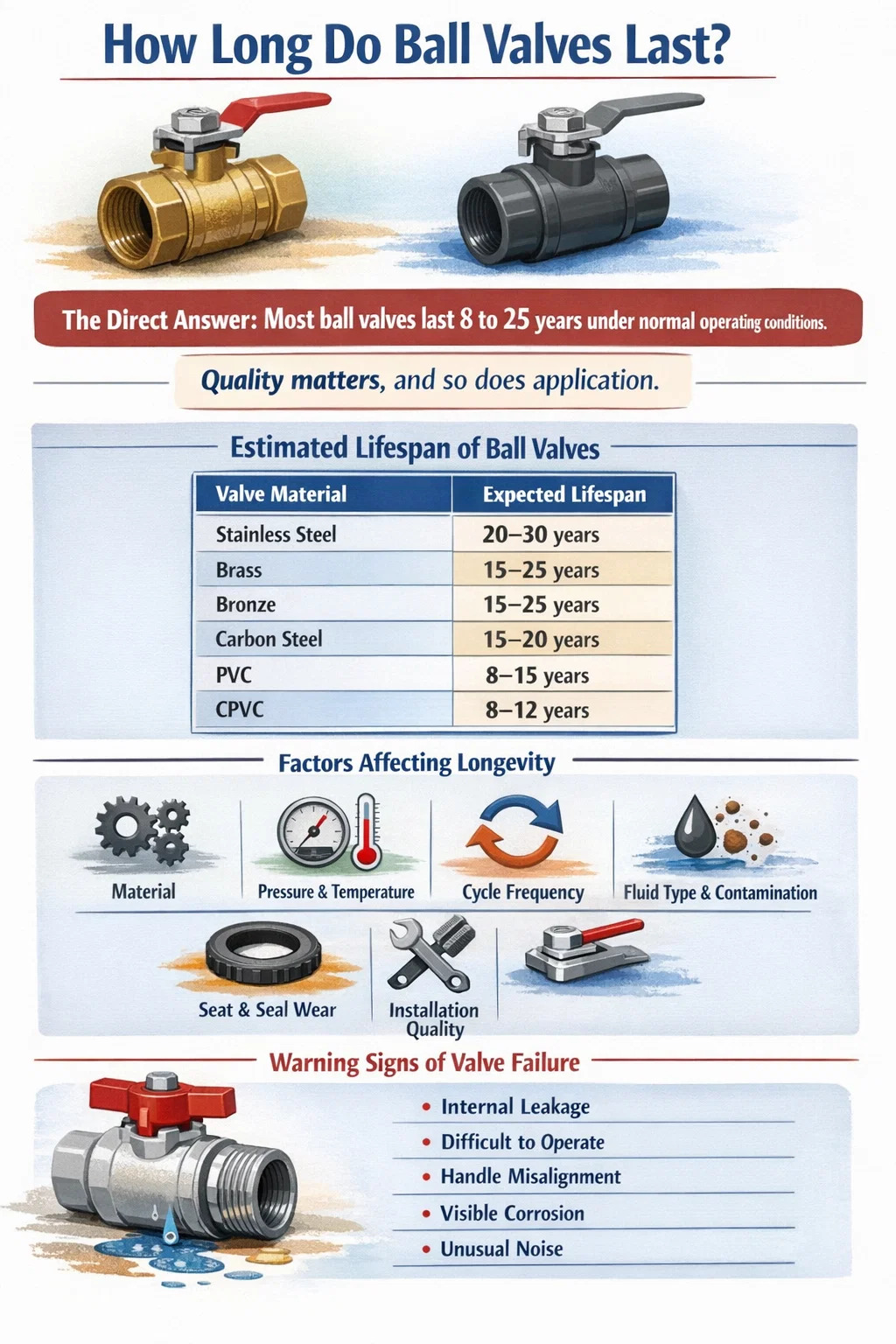
Most ball valves last 8 to 25 years under normal operating conditions. The exact lifespan depends on the material, operating environment, fluid type, and maintenance frequency. A brass ball valve in a residential water supply line can easily reach 20+ years, while a plastic ball valve in a chemically aggressive industrial setting may fail within 3 to 5 years. The short answer is: quality matters, and so does application.
Ball valves are among the most durable quarter-turn valves available. Compared to gate valves or globe valves, they have fewer moving parts, offer tighter shut-off, and resist wear better over time. That said, no valve lasts forever, and understanding what drives longevity will help you plan replacements, select the right valve upfront, and avoid unexpected system failures.
Ball valve lifespan is not a fixed number. Several variables combine to either extend or shorten the operational life of any given valve.
The body material is the single biggest driver of durability. Stainless steel ball valves routinely last 20 to 30 years in clean water or mild chemical service. Brass ball valves perform well in potable water and HVAC systems, typically lasting 15 to 25 years. Bronze ball valves are preferred in marine environments and can match stainless steel lifespans when properly selected. PVC and CPVC ball valves are cost-effective but degrade faster under UV exposure, high temperatures, or solvent-heavy fluids — expect 5 to 15 years depending on conditions.
The seat is the component that wears first in most ball valves. PTFE (Teflon) seats are the industry standard and offer excellent chemical resistance, but they can deform under high temperatures above 200°C or in high-cycle applications. PEEK and reinforced PTFE seats handle more demanding conditions and extend the valve's useful life significantly. When seats wear out, the valve begins to leak internally, which is usually the first sign that replacement or reseating is needed.
Ball valves rated at 1000 PSI running at 200 PSI will last far longer than one running at its maximum rated pressure continuously. Heat accelerates seal degradation, especially in polymeric seat materials. A valve operating at 90% of its temperature rating will see noticeably shorter seat life than one used at 50% capacity. Always leave a margin — select a valve rated well above your actual operating parameters.
Industrial-grade ball valves are often rated for 100,000 to 1,000,000 cycles before significant wear occurs. A residential shut-off valve that is operated only a few times per year will outlast a process control valve cycled hundreds of times per day. High-cycle applications require valves specifically designed for that duty — standard valves will fail prematurely in those conditions.
Clean water is gentle on valve internals. Slurries, abrasive particles, and corrosive chemicals are not. Ball valves handling abrasive fluids like sand-laden water or mineral slurries suffer accelerated wear on the ball surface and seat. Corrosive chemicals attack body and seat materials if the wrong valve material is selected. Particle contamination can also jam the ball mechanism or embed in seats, causing leakage long before the valve material itself degrades.
Poor installation is a silent killer of valve life. Pipe misalignment creates stress on the valve body. Over-tightening threaded connections can crack valve bodies, especially in brass and PVC valves. Incorrect flow direction in trunnion-mounted ball valves reduces sealing efficiency. Installing a valve with the stem pointing downward in dirty service allows debris to accumulate around the stem packing, accelerating wear. Following manufacturer installation guidelines matters far more than most users realize.
The table below summarizes typical ball valve lifespan ranges across common materials and application types:
| Valve Material | Typical Application | Expected Lifespan |
|---|---|---|
| Stainless Steel (316) | Chemical processing, food & beverage | 20–30 years |
| Brass | Plumbing, HVAC, potable water | 15–25 years |
| Bronze | Marine, seawater service | 15–25 years |
| Carbon Steel | Oil & gas, steam lines | 15–20 years |
| PVC | Water treatment, irrigation | 8–15 years |
| CPVC | Hot water, mild chemicals | 8–12 years |
These figures assume reasonable operating conditions and periodic inspection. Harsh environments, abrasive media, or neglected maintenance will push actual lifespans toward the lower end of these ranges.
Ball valves tend to fail gradually rather than catastrophically. Catching early warning signs allows for planned replacement rather than emergency shutdowns.
If any of these signs appear in a critical system — high pressure, high temperature, or handling hazardous fluids — replacement should not be delayed. Even minor leakage in these contexts is a serious safety concern.
With the right practices in place, you can push a quality ball valve well past its minimum expected lifespan.
Ball valves that sit in one position for years without being operated are prone to seizing. The PTFE seats can cold-flow and bond to the ball surface. A standard maintenance practice is to fully open and close all valves at least once per year, even those that are never normally operated. This prevents seat bonding, keeps the stem packing flexible, and ensures the valve will actually work when needed in an emergency.
Oversizing or undersizing a ball valve is a common mistake. A valve that is too large for the flow may trap sediment; one that is too small runs at higher velocity and accelerates erosion. Match the pressure and temperature rating to your actual conditions with a safety margin. For corrosive environments, consult chemical compatibility charts — not every stainless steel grade resists every acid. For example, 316 stainless steel resists dilute sulfuric acid but is attacked by hydrochloric acid; in that case, a Hastelloy C276 ball valve would be the appropriate choice.
Rapid valve closure generates pressure shocks known as water hammer. These shocks create massive instantaneous pressure spikes — sometimes 10 to 50 times the normal line pressure — that stress valve bodies, seats, and connected piping. In systems prone to water hammer, install surge suppressors or actuated ball valves with controlled close rates. Quarter-turn valves like ball valves are particularly susceptible because full closure happens in just 90 degrees of travel, which can be very fast with a manual or spring-return actuator.
Threaded-end ball valves are vulnerable to external corrosion at the thread interface, especially in outdoor or humid environments. Apply anti-corrosion thread compound, use protective coatings on exposed valve bodies, and consider stainless or epoxy-coated valves for outdoor installations. For buried valves, use valves rated for direct burial with appropriate coatings or wrapping.
Many ball valve designs allow the stem packing to be adjusted or replaced without removing the valve from the line. If you notice minor stem weeping, tightening the packing nut a small amount (typically no more than a quarter turn at a time) often stops the leak and extends the valve's useful life without requiring full replacement. Do not over-tighten — excess packing compression increases operating torque and can damage the stem.
New pipework often contains welding slag, pipe scale, thread compound residue, and construction debris. Running these materials through a ball valve before the line is properly flushed can score the ball surface or embed particles in the soft PTFE seats permanently. Always flush new piping systems with valve internals removed or valves in the fully open position before normal operation begins.
The way ball valves age varies significantly across different sectors, driven by the specific demands placed on them.
In household water supply systems, ball valves are about as close to a "set and forget" component as exists in plumbing. A quality brass or chrome-plated ball valve installed on a cold water main supply may go 20 to 30 years without any attention whatsoever. The main risk in residential settings is the valve seizing from inactivity — it gets installed, never touched for 15 years, and then fails to close in an emergency because the seat has cold-flowed against the ball. The plumbing itself often wears out before the valve does.
Ball valves in heating and cooling systems see moderate cycling and work with relatively clean water or glycol solutions. Lifespan here typically runs 15 to 20 years, with the main aging factors being glycol concentration (which can become acidic over time if not maintained), thermal cycling stress, and the quality of the original water chemistry management. Poorly maintained glycol systems that become acidic will attack brass valve bodies and degrade PTFE seats faster than normal.
This sector uses some of the most demanding ball valve specifications. Trunnion-mounted ball valves in pipeline service are engineered for 20 to 30 year service intervals but require regular inspection and maintenance programs to achieve that. Subsea ball valves face external seawater corrosion in addition to internal process fluid challenges and are typically inspected on 5-year cycles regardless of apparent condition. API 6D is the governing standard for pipeline ball valves, and certified valves under this standard are designed with long-haul performance in mind.
Water treatment facilities often use large-diameter ball valves in chlorinated or fluoridated water service. Chlorine is corrosive to many metals at elevated concentrations, which is why PVC or CPVC ball valves are common in this sector despite their shorter service life compared to metals. Stainless steel valves are used where plastic pressure ratings are insufficient. Typical replacement cycles in water treatment are 10 to 15 years for plastic valves and 20+ years for properly specified metal valves.
Sanitary ball valves in food and beverage applications face frequent cleaning-in-place (CIP) cycles using caustic soda and acid cleaning solutions, plus high-temperature steam sterilization. These conditions accelerate seal wear significantly. Seat replacement every 2 to 5 years is common in high-cycle sanitary applications, even when the valve body itself remains in excellent condition. Full valve replacement typically occurs every 10 to 15 years in these environments.
Not every failing ball valve needs to be thrown away. In many cases, a seat replacement kit or full internal rebuild kit can restore a valve to like-new performance at a fraction of replacement cost — particularly for larger valves where the body itself represents significant material value.
Rebuild is generally worthwhile when:
Replacement is the better option when:
For a 6-inch (DN150) stainless steel ball valve, a full rebuild with new seats, stem packing, and body seals might cost $200 to $500 in parts, compared to $1,500 to $4,000 or more for a new equivalent valve. The economics of rebuilding large-diameter ball valves are compelling when the body condition supports it.
Yes — significantly. The ball valve market ranges from precision-machined, full-port valves with certified materials and tight dimensional tolerances down to import commodity valves where body wall thickness, alloy composition, and seat quality vary widely from batch to batch.
Key quality indicators to look for when selecting ball valves:
Established manufacturers such as Flowserve, Emerson (Fisher), Velan, Trunnion, and Kitz consistently produce valves that meet or exceed rated lifespans in the field. Budget commodity valves may appear identical but often deliver substantially shorter service lives in practice.
A simple, consistent maintenance schedule dramatically extends ball valve service life and prevents unexpected failures. The appropriate frequency depends on the severity of service.
| Service Type | Recommended Inspection Interval | Key Checks |
|---|---|---|
| Residential / low cycle | Annual | Exercise valve, check for stem leaks |
| Commercial HVAC | Annual or per maintenance contract | Exercise, inspect body, check water chemistry |
| Industrial process (mild service) | Every 2–3 years | Full inspection, seat leak test, packing check |
| Industrial process (severe service) | Every 12–18 months | Internal inspection, seat replacement if needed |
| High-cycle automated valves | Every 6–12 months | Full internal check, actuator torque verification |
| Subsea / critical safety service | Per regulatory requirement (typically 5 years) | Full overhaul, NDE inspection of body |
When a ball valve finally reaches the end of its service life, the replacement decision is an opportunity to upgrade. Simply replacing like-for-like is not always the best approach.
If a brass ball valve in a chemical dosing line failed after only 5 years due to corrosion, replacing it with another brass valve will produce the same result. Analyze why the previous valve failed and select a material better suited to the actual service conditions. In this scenario, a PVDF or stainless steel valve might offer three to five times the lifespan at a modest cost premium.
Full-port (also called full-bore) ball valves have no restriction in the flow path when fully open. This reduces pressure drop, minimizes turbulence-related erosion, and makes the valve piggable in pipeline systems. If the original installation used a reduced-port valve and erosion was a problem, switching to full-port will extend the next valve's life.
If a manually operated valve is being cycled many times per day, the torque inputs from manual operation create wear patterns on seat surfaces that actuator-operated valves avoid with their more consistent and controlled operation. Pneumatic or electric actuators with adjustable close speeds can significantly extend seat life in high-cycle applications compared to aggressive manual operation.
Recommended Products
Copyright © Yancheng Yanye Hydraulic Parts Co., Ltd. All Rights Reserved
Custom Ball Valve Factory
China Ball Valve Manufacturers




 English
  русский
  Español