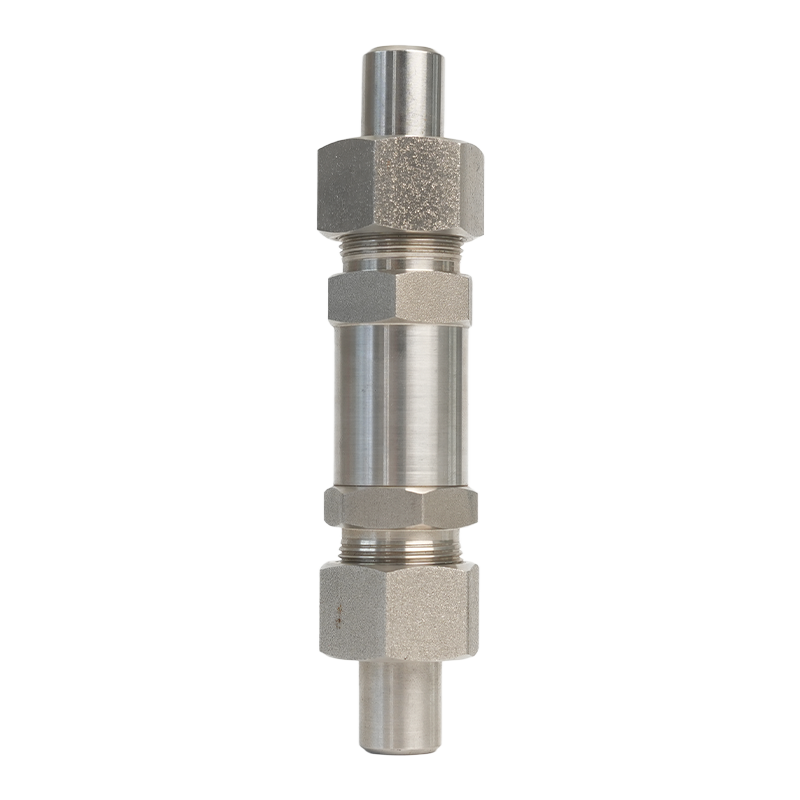
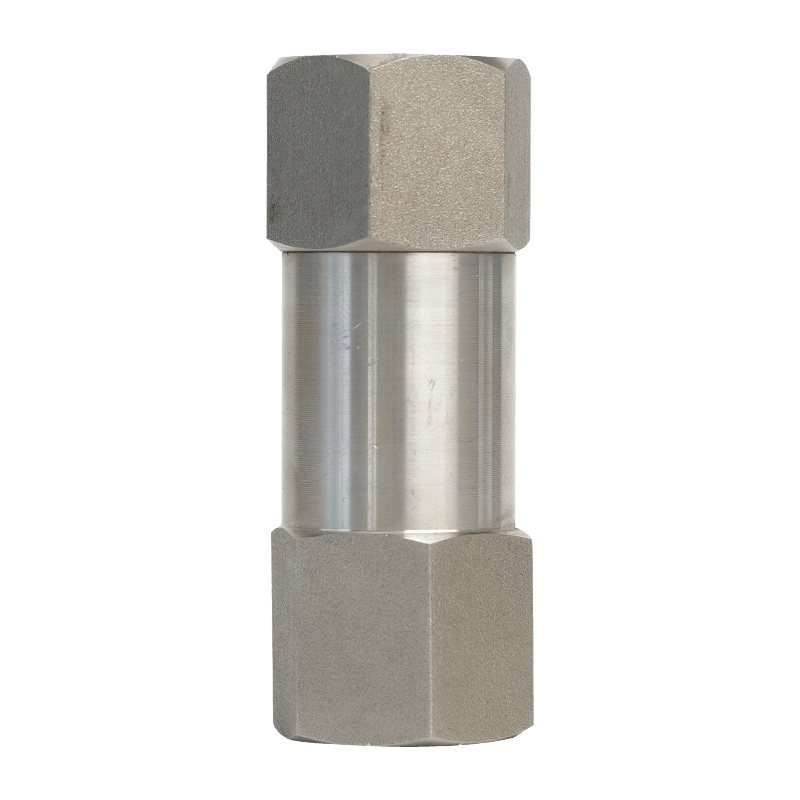
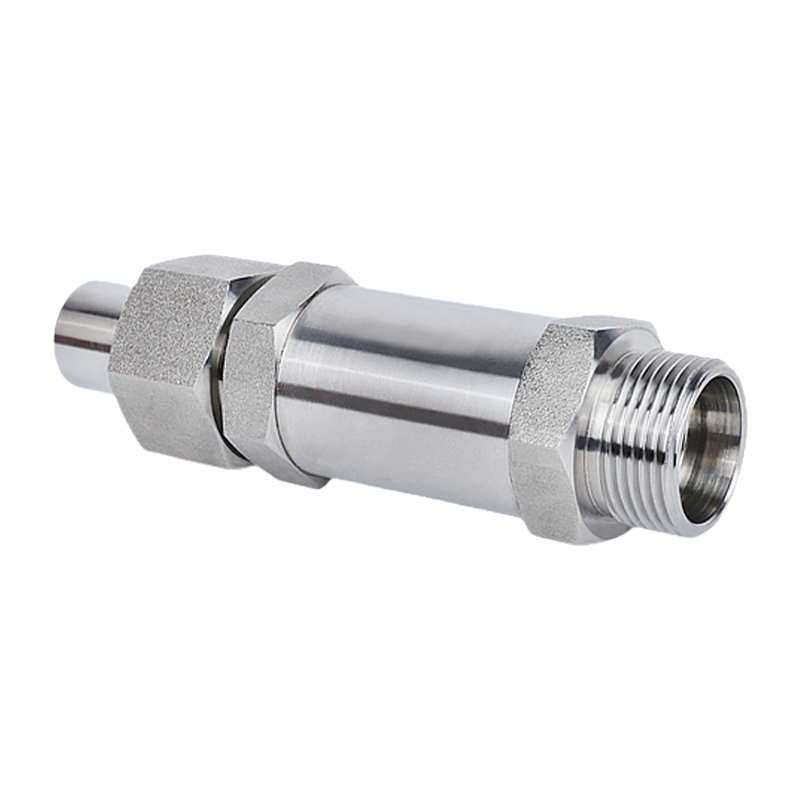
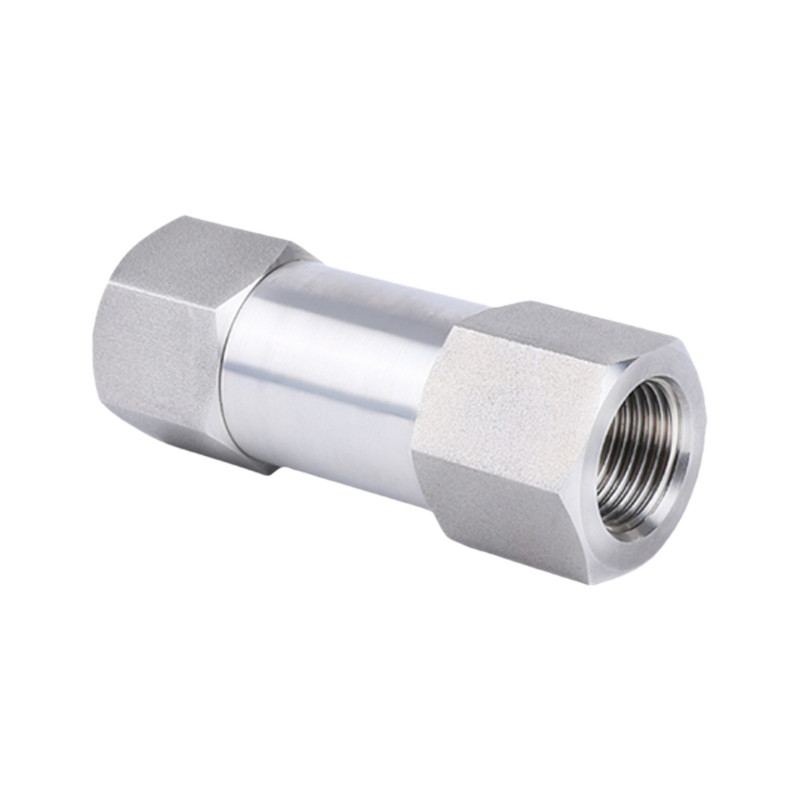
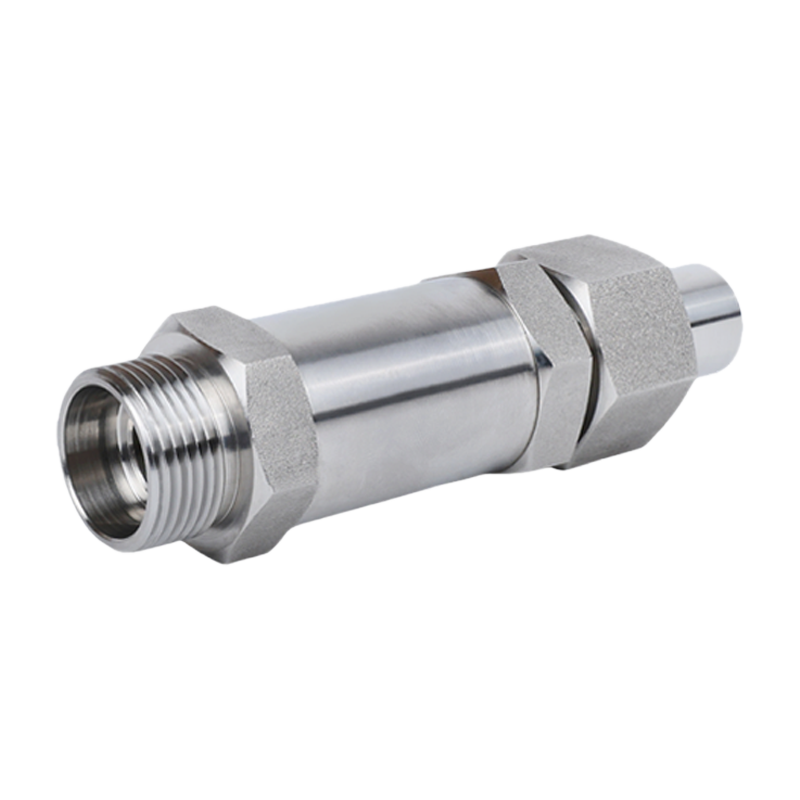
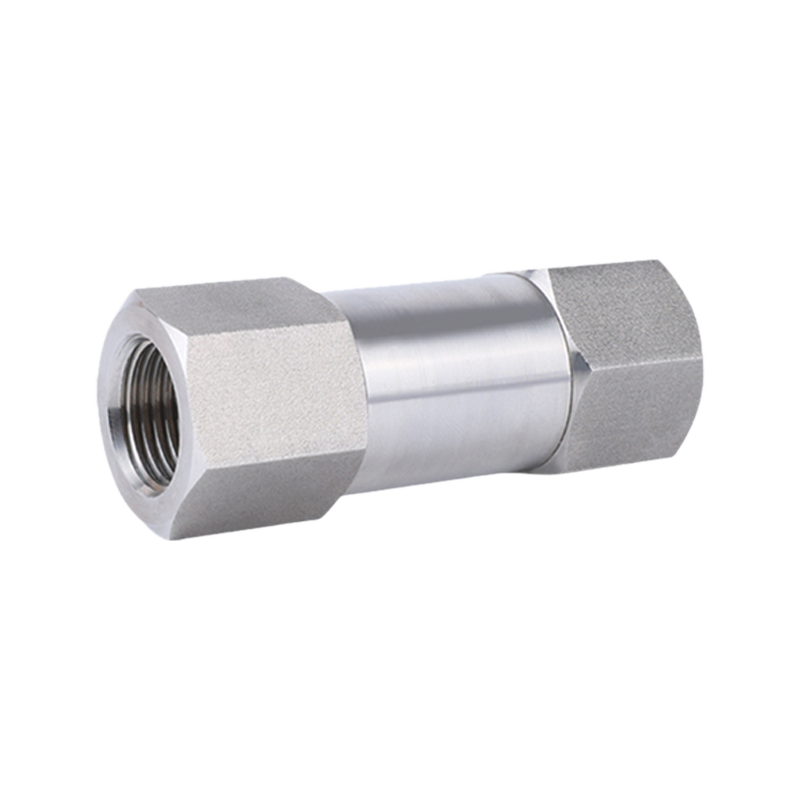
Stainless Steel One-way Check Valve, also known as a check valve or non-return valve, is a fluid control device. Its core function is to prevent the reverse flow of fluid in a specific direction, while allowing the fluid to flow freely in the other direction. In the closed state, the fluid is completely blocked by the one-way valve, forming a closed area. When the fluid tries to flow from downstream to upstream, the one-way valve will automatically open due to the pressure difference, allowing the fluid to pass smoothly. When the fluid tries to flow from upstream to downstream, the pressure difference will cause the valve core to close tightly, thereby preventing the fluid from flowing back.
The structure of the one-way valve mainly includes the valve body, valve core and spring. The valve body is the skeleton of the one-way valve, the valve core is the main working part, and the spring ensures its normal operation under a certain pressure. Different types of one-way valves may differ in structure to adapt to different application scenarios and fluid characteristics.
Advantages:
1. High reliability: usually adopts a simple mechanical structure, does not require electricity or other external support, so it has high reliability and can extend the life of the system.
2. Small size: Compared with other valve types, it is smaller in size and suitable for occasions with limited space.
3. Simple and easy to maintain: The structure is simple, and it is easy to disassemble and maintain.
4. Applicable to a variety of media: It can handle a variety of media, including liquids and gases. By selecting different materials, it can be applied to a variety of media such as water, steam, oil, nitric acid, acetic acid, strong oxidizing media and urea.
5. Relatively low price: The price is relatively cheap, which helps to reduce the cost of the system.
**Abstract** Pneumatic ball valves are quarter-turn rotary valves actuated by compressed air, widely used for on/off and diverting service in process industries. Their appeal lies in fast actuation, ...
View MoreA three-way ball valve on a hydraulic test bench that diverts oil between a filter loop and a return line often runs for years on a hand lever, then fails the same week an electric actuator is fitted...
View More**Abstract:** Metal piping systems form the circulatory backbone of heavy industry, and the humble pipe clamp is the critical interface between that vibrating, thermally cycling, sometimes corrosive a...
View More1. Introduction Industrial valves regulate, direct, or control the flow of liquids, gases, slurries, and steam within piping systems by opening, closing, or partially obstructing passageways. Select...
View MoreYancheng Yanye Hydraulic Parts Co., Ltd. manufactures Stainless Steel Oneway Check Valve for hydraulic, water, gas, chemical and fire-protection circuits. Our Funing County factory supplies six standard body styles and builds non-standard variants to drawing.
The range covers threaded end connections from DN6 to DN50-class piping, with 304 and 316L wetted bodies, spring-loaded discs and optional integral strainers or fire arresters. Every unit is pressure-tested before it leaves the warehouse.
Our stainless oneway check valve family is organised by connection and by the auxiliary function integrated into the body. The core mechanism is identical: a spring-loaded disc lifts at a defined cracking pressure and seats when downstream pressure rises, isolating the reverse path without electricity or external actuation.
External thread one-way check valve and internal thread one-way check valve for inline mounting in pump discharge, HVAC and water-treatment lines.
External thread strainer and internal thread strainer versions combine coarse filtration with non-return protection ahead of pumps, nozzles and instruments.
External thread fire arrester check valve and internal thread fire arrester check valve add flame-path protection for gas and fuel-gas trains.
Because the valve is passive and needs no power supply, it suits circuits that must hold direction after a shutdown, during a power failure or whenever a pump is bypassed for maintenance. The stainless body keeps the flow path clean in water treatment, food and pharmaceutical lines where carbon steel would corrode or shed oxide.
Six variables drive the final configuration: nominal size and thread standard, body material, cracking pressure, sealing material, medium temperature and the end connection pair. We confirm all of them at quotation stage so that the delivered unit matches the installed pipe.
| Variable | Typical Options | Engineering Comment |
|---|---|---|
| Body material | 304 / 316L stainless | 316L for chlorides and marine air |
| End connection | External or internal thread; BSP/NPT | Matched to mating pipe or port |
| Cracking pressure | Light, standard or heavy spring | Set to balance opening loss and seat tightness |
| Sealing | Metal-to-metal or elastomer seat | Elastomer for bubble-tight low-pressure sealing |
| Medium | Water, oil, gas, chemicals | Strainer variant for dirty media |
| Temperature | Ambient to elevated process heat | Seat and spring material chosen to suit |
Pressure-loss profile by body style
Relative flow resistance; final values depend on size, spring and medium.
We machine bodies from 304 and 316L bar and cast stock. 304 covers general water and neutral media; 316L adds molybdenum for chlorides, acetic acid, nitric acid and food-grade cleaning cycles. Seat and spring alloys are selected against the medium so that the disc releases cleanly after long idle periods.
304 Stainless
Water, steam, neutral fluids, general hydraulic oil.
316L Stainless
Chloride-bearing water, marine air, chemicals, food and pharma.
Seat Options
Metal-to-metal for high temperature; elastomer for tight low-pressure closing.
Threaded ends let the valve be installed directly into pump ports, manifolds and pipe runs without welding. Match the thread standard to the mating component (BSPP, BSPT or NPT), apply a compatible sealant, and observe the arrow on the body: flow must pass from inlet to outlet in the direction of the disc lift.
For horizontal lines, mount with the spring housing upright so that gravity assists seating; for vertical lines, flow upward is preferred. A strainer body should be positioned where the screen can be removed without dismantling the adjacent pipe.
Inspection reports accompany consignments on request. Our management system is certified to ISO 9001:2015, and we produce against DIN 2353 and DIN 3015 practice where piping interfaces require it. Acceptance can include seat-leak verification at the specified cracking pressure, thread gauging and material certification review.
Our engineering team supports OEM and ODM work: private labelling, custom thread combinations, special spring rates, body engraving and project-specific packaging. Send drawings in .dwg or .step format and we will return a configuration that fits your manifold or skid.
The valve is field-serviceable. Seat and spring kits are available as spares; replacement requires only the removal of the body from the line, not the destruction of the housing. For strainer variants, the screen is removable for cleaning. We supply PDF catalogs, 2D/3D CAD files and technical datasheets with each order.
To prepare a proposal we need the working point, connection details and any compliance requirement. The following list is our standard RFQ input sheet.
What is the difference between the external and internal thread models?
External thread models carry male threads and thread into a female port; internal thread models carry female threads and accept a male pipe end. Internally, both use the same spring-loaded disc. Selection depends only on the mating connection and the available installation space.
Can the cracking pressure be customized?
Yes. We select spring rate against your required opening pressure and expected flow. Low-cracking springs reduce pressure loss in gravity-fed or low-head circuits; heavier springs hold the disc closed against pulsation in pump discharge lines.
Do you supply 316L bodies for seawater or chemical service?
We machine 316L bodies on request for chloride-bearing and mildly aggressive media. Provide the medium concentration and temperature so that the body and seat alloys are matched to the service.
What testing is performed before shipment?
Each valve passes a full-pressure test, a seat-leak check and dimensional verification. Material spectro-analysis and thread gauging are recorded during production. Inspection reports can be issued with the consignment.
What is the typical lead time for standard and custom valves?
Standard products ship 15–30 days after deposit; custom or large orders take 30–60 days or as negotiated. A production schedule is issued at order confirmation.
Can you supply CAD drawings and datasheets for our project file?
Yes. PDF catalogs, 2D/3D CAD files in .dwg or .step format and detailed technical datasheets are available for all models in the range.
For related flow-control items, see our Hydraulic Ball Valve Suppliers range and the One Way Valve Check Valve series.
Copyright © Yancheng Yanye Hydraulic Parts Co., Ltd. All Rights Reserved
China Stainless Steel One-way Check Valve Manufacturers




 English
 русский
 Español